
Ship with shared context.
Kanban taskboards with WIP analytics, deliverable hierarchies with est-vs-actual, team capacity across Overview, Roster, Timeline, and Gantt, plus twelve operational reports — engineers, designers, and PMs align on one portfolio view.
Delivery teams need shared context — what is on the board, who has capacity, which deliverables drift from estimate, and where files and decisions live. Eighteen project screens cover taskboard, capacity, deliverables, reports, and collaboration without forcing PMs to maintain parallel trackers.
Built for organizations that sell, deliver, and employ at scale.
Professional services firms, consulting organizations, technology delivery teams, GCCs, BPOs, agencies, and corporate operations groups — one workspace connects the work your teams already do.
- Friction 01
Shadow boards
Engineers track real work in personal tools — official taskboard stale.
- Friction 02
Capacity arguments
Sprint planning without Roster or Timeline data — commitments based on gut feel.
- Friction 03
Estimate surprises
Deliverables missing estimates surface late on gap lists.
What changes with Tracopus
- Kanban taskboard with documented WIP charts
- Four team capacity views
- Deliverable hierarchy with est-vs-actual
- Files, chat, notes in project context
Capacity you can act on.
Overview gauges, roster grids, timeline bars, and Gantt — shared context for PMs and engineers without parallel trackers.
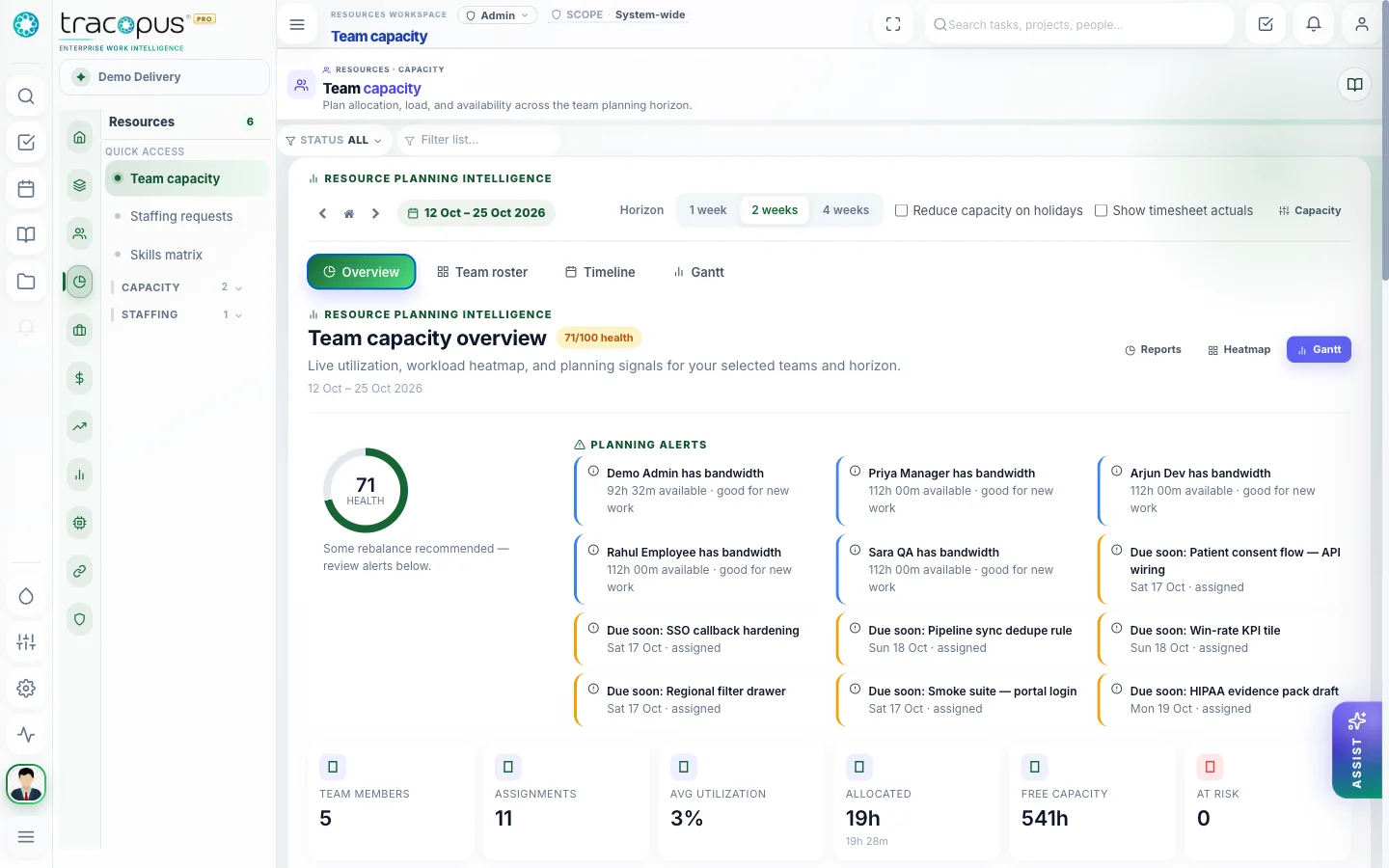
Overview, roster, timeline, and Gantt in one capacity workspace.
Delivery governance that scales
Gantt, risks, issues, tickets, stage gates, NPD, dossiers, portfolio control tower, resource staffing, and knowledge capture on one delivery surface.
Portfolio control tower
Executive roll-up across delivery, resources, risk, finance, revenue, approvals, and integration health.
Gantt & dependencies
Project timelines, milestone tracking, dependency management, and critical path visibility.
Risks, issues & gates
Risk register, issue tracker, action items, decision logs, change logs, and stage-gate approvals.
Tickets & service
Ticket intake linked to projects, clients, SLAs, timesheets, billing, and governance.
Task board & work items
Kanban execution, deliverable hierarchies, Work Item activity, est-vs-actual, and status transitions.
Resource planning
Skills, staffing requests, allocations, bench, roll-offs, utilization, and AI staffing recommendations.
NPD pipeline
Ideas, business cases, prototypes, stage gates, launch readiness, and links into project governance.
Dossier management
Structured dossier sections, linked documents, review/approval, baselines, exports, and legal hold.
Knowledge & RCA
Lessons learned, root cause analysis, recurring issue patterns, and preventive controls.
Accounts & commercial context
Customer accounts, bid requests, and purchase orders that seed delivery with contract clarity.
How work moves through Tracopus
Sprint execution
Board + capacity loop.
- 1Staff sprint using Team capacity Roster tab
- 2Run taskboard with project and assignee filters
- 3Review est-vs-actual on deliverable detail mid-sprint
Questions for this module
What teams usually ask before rolling this area out.
What capacity views exist?
Overview gauges, Roster grid, Timeline allocation bars, and Gantt project view — all on team capacity screen.
One Operating Layer. Every Enterprise Workflow.
Bring workspace, people, projects, resources, finance, payroll, performance, analytics, AI agents, integrations, and admin governance into one persona-aware luxury platform.